Odd-e Japan team member Asada attended the session "Color Outside the Lines: Graphic Facilitation 101 (Playing in the Scrum Sandbox)" presented by Tamsen Mitchell during the Global Scrum Gathering® Minneapolis 2018, hosted by Scrum Alliance® from April 16th to 18th, 2018. Here is his report on the experience.
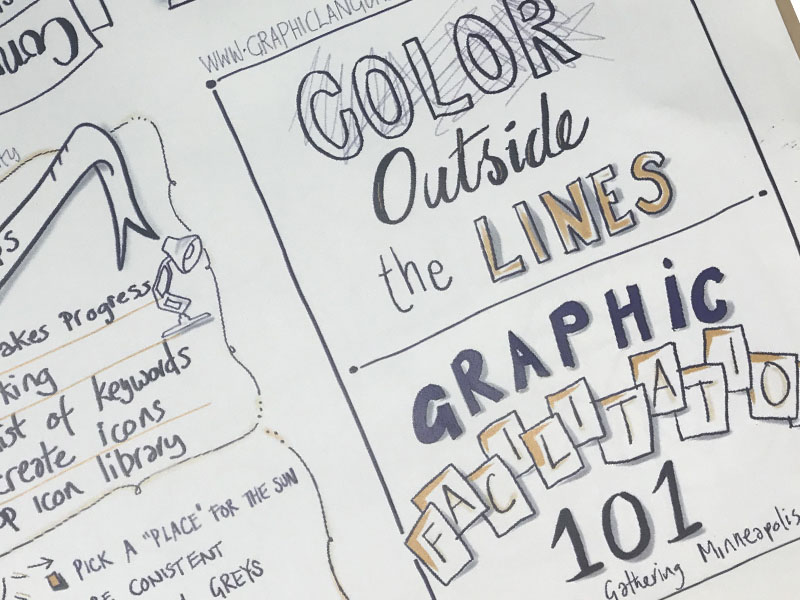
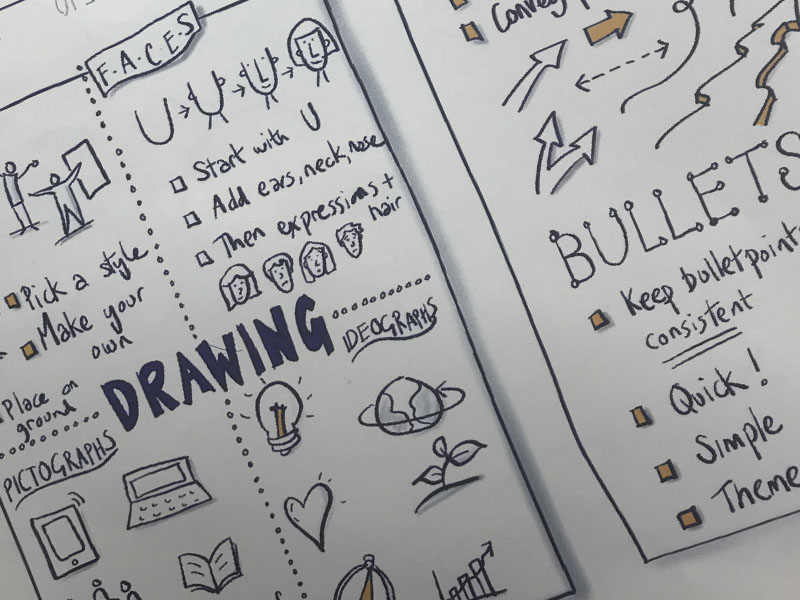
When you hold a meeting, do you use whiteboards or flip charts? They are essential tools for visualizing opinions, comparing ideas during discussions, and summarizing final decisions. But how do you usually record those thoughts? To make them easier for participants to read, you might:
While there are many techniques, most people probably rely primarily on text. Graphic Facilitation is the skill of summarizing opinions and decisions using "images" rather than just "words."
There are two major advantages to Graphic Facilitation:
"I see the benefits, but only people who are good at drawing can do it, right?" This is a common concern.
I also used to think I couldn't do it because my drawing skills are quite poor. However, drawing ability isn't an issue. In reality, you only need simple sketches that can be drawn quickly during facilitation. Don't you think you could draw simple symbols for a "person," "house," "arrow," or "car"?
The secret to Graphic Facilitation I learned in this workshop is that it's about the "inventory of images" rather than "artistic skill." The crucial skill is the ability to instantly visualize an opinion without overthinking it. To draw reflexively, you need an internal "stock." The larger your inventory, the faster you can draw.
So, how do you build this stock and improve your skills? In this workshop, they introduced methods across three levels: Beginner, Intermediate, and Advanced. Let's give it a try!
Try drawing 30 graphics in a short amount of time.
Start by drawing whatever comes to mind without overthinking.
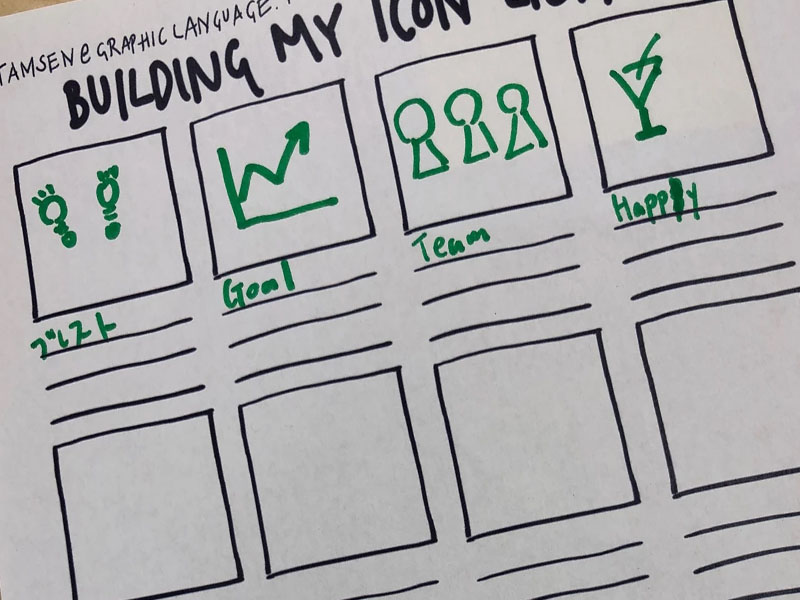
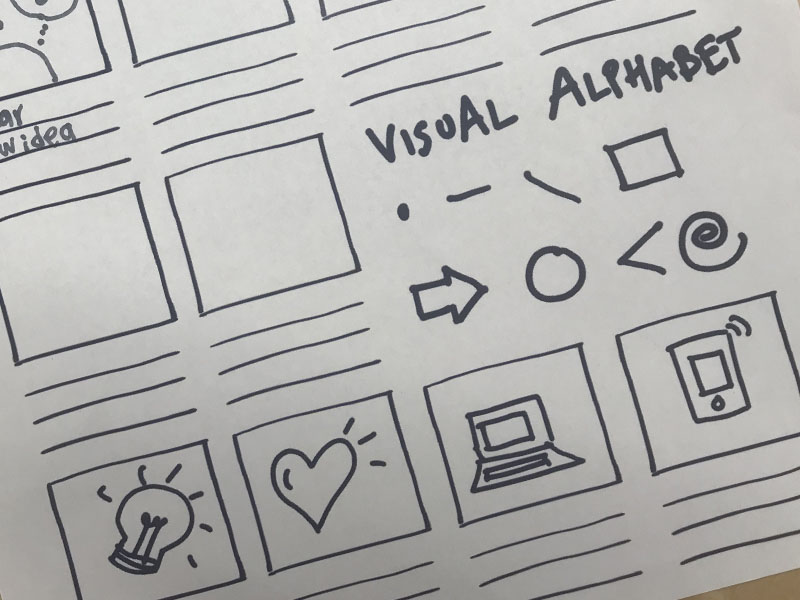
When told to draw for 5 minutes, I couldn't draw much at all...
I recommend focusing on quantity without worrying about artistic quality, being embarrassed, or wondering "is this useful for a meeting?"
For example, a "light bulb" could represent "when a new idea emerges."
That's it for the beginner level. To do Graphic Facilitation, it's vital to build your own internal dictionary of which icons to use and when.
Having this preparation allows you to draw reflexively. By expanding this dictionary daily, your skills will grow. If you're stuck for ideas or wondering what quality is required, look at the "Visual Alphabet" in the photo above.
These shapes are the bare minimum parts for drawing. Anything you can create by combining these "Visual Alphabet" elements is more than enough.
Doesn't that give you a bit more confidence, even if you aren't an artist?
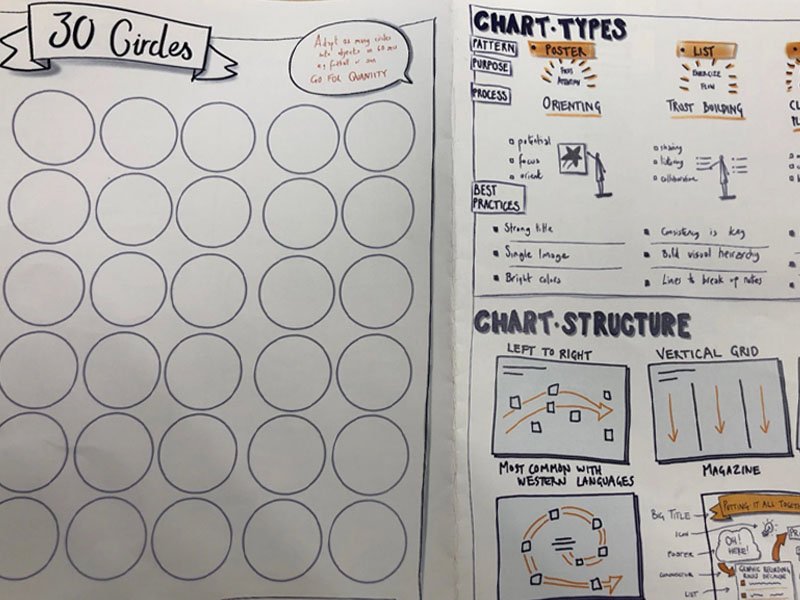
If you can draw 30 icons in 5 minutes, you've cleared the beginner level.
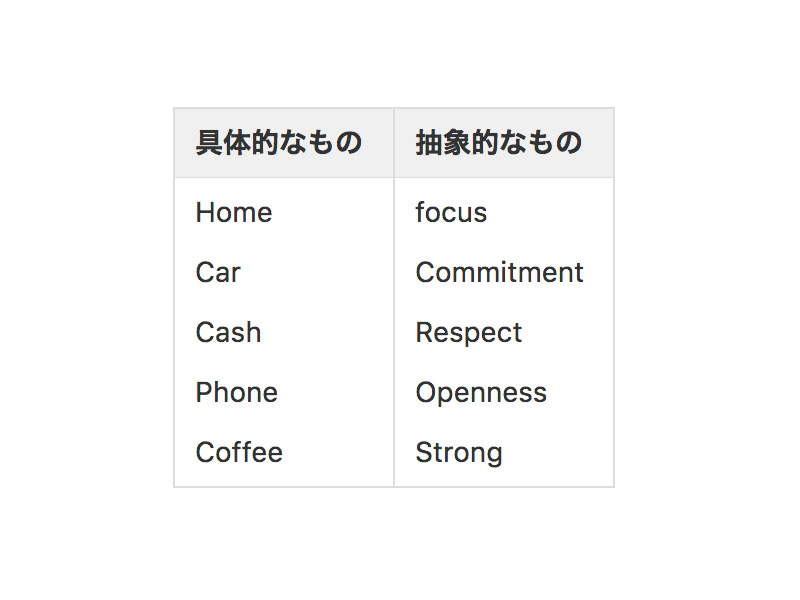
Try drawing the words in the table above. If you've cleared the beginner level, you can probably draw the "concrete objects" in the left column easily.
But what about the "abstract concepts" in the right column? While concrete things are simple, abstract ones are tricky. Also, everyone's answer is different, making it hard to draw something everyone immediately understands.
Take the word "Strong," for example. What would you draw? I drew a "bicep," but looking around, many people drew weapons like "swords." I noticed many people drawing "guns," which felt like a very "American" cultural touch (laughs).
Practice drawing abstract concepts. Build an inventory that other participants can recognize and understand.
Expanding your stock of abstract icons is the core of the intermediate level. Once you can represent abstract ideas in a way everyone understands, you've cleared this level.
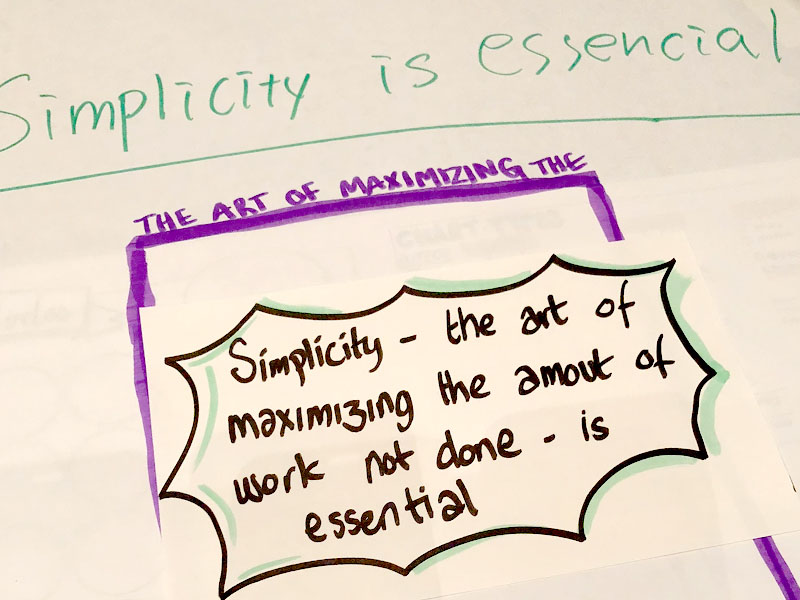
After concrete (Beginner) and abstract (Intermediate) words, your final challenge is "Sentences." In this workshop, groups were given random sentences and told to think about how to represent them visually.
For example, try drawing the sentence above. If you can express a full sentence using your inventory of icons, you could say you've mastered Graphic Facilitation. Though, let's be honest—it's incredibly difficult. During the workshop, I couldn't visualize it at all (tears).
While turning sentences into images takes time, I realized I can build my stock bit by bit. If you want to improve your facilitation skills, why not start by drawing whatever you can during the meetings you facilitate?
Don't be shy—start by sketching on the whiteboard during your next meeting!
Summary:
The brain processes images 60,000 times faster than text. Using images helps communicate ideas with clarity, alignment, and engagement. Come to the workshop to learn how, even if you don't regularly draw!
Learning Objectives:
Advance your facilitation skills
Build a visual library of icons to use in coaching or facilitation
Demonstrate easy ways to up your flip chart skills
Learn how to express ideas and solve problems using visual language
Speakers:
Tamsen Mitchell
Reference Information
■ Tamsen Mitchell - Speakers
Principal
Graphic Language
It all started when... Tamsen found her passion in cognitive neuroscience and humor. No, really.
Her company, Graphic Language, grew out of her thirst for knowledge in coaching and humor - and becoming fluent in a universal language. It was founded after years of research into what makes information compelling and memorable. She trained as an architect at the Mackintosh School of Architecture / Glasgow School of Art, and spent the last 20 years in technology - helping people "get stuff created".
Her experience with Activision, Pixar, LinkedIn and Salesforce provides a robust visual and storytelling basis for a range of topics.
She's a frequent conference speaker on storytelling, humor and visualization she now channels this to help her clients get the big picture, using fancy digital medium, or using good old pen and paper.
■ Facebook - Graphic Facilitation Group
Members of Odd-e Global are also part of this community!
Facebook - Graphic Facilitation Group
Other Reports from Global Scrum Gathering® Minneapolis
Global Scrum Gathering® Minneapolis
Our Open Space Experience
Graphic Facilitation Workshop Report
Recommended Books & Sites for Agile/Scrum
Agile Marketing Insights
We are here to help with your challenges regarding Agile and Scrum, or any questions about our training and coaching services.
Please feel free to contact us.